


TL;DR
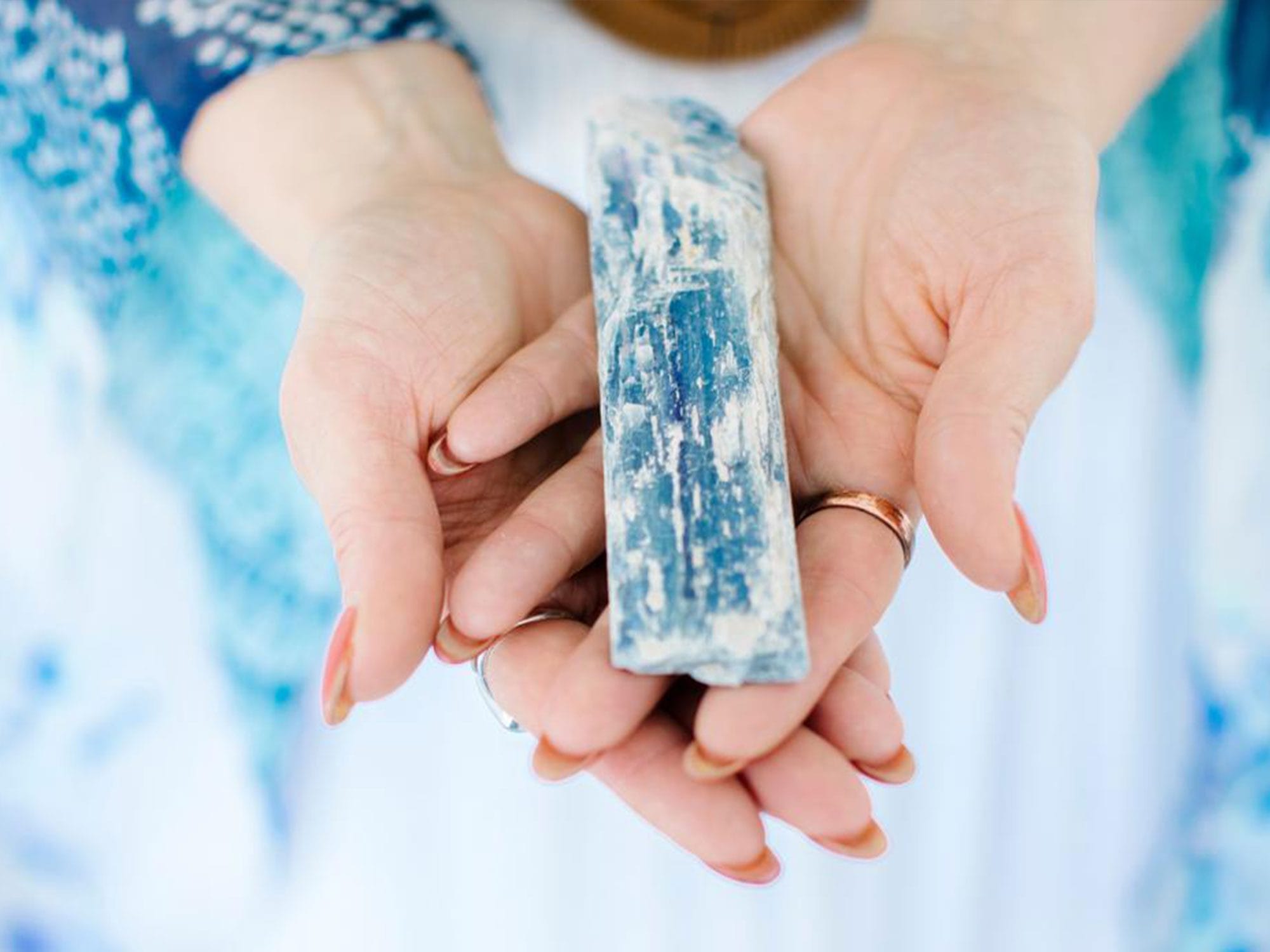
Kyanite is a triclinic aluminium silicate (Al₂SiO₅) known for its blade-like crystals and distinctly variable hardness — 4.5–5 along the blade, 6.5–7 across it. Named in 1789 by Abraham Gottlob Werner after the Greek kyanos (blue), it forms in high-pressure metamorphic rocks and occurs in blue, black, green, orange, and, rarely, colourless varieties. A polymorph of andalusite and sillimanite, kyanite is valued industrially for ceramics and refractories, and by collectors and crystal enthusiasts for its striking bladed crystals and metaphysical associations with clarity and communication.
Kyanite is one of mineralogy’s most structurally unusual stones — a blade-forming aluminium silicate found in high-pressure metamorphic rocks, celebrated for a physical property so distinctive it is used to teach mineralogy students about anisotropism. This guide covers everything worth knowing about kyanite: its mineralogy and geological origins, the science behind its variable hardness, its relationship to andalusite and sillimanite, its meaning in crystal-healing tradition, and the full spectrum of its colour varieties — from the widely loved blue kyanite through to the rarer orange and the striking ruby in kyanite combination stone.
Kyanite at a Glance
| Property | Detail |
|---|---|
| Chemical Formula | Al₂SiO₅ |
| Mineral Group | Nesosilicates (Aluminium silicates) |
| Crystal System | Triclinic |
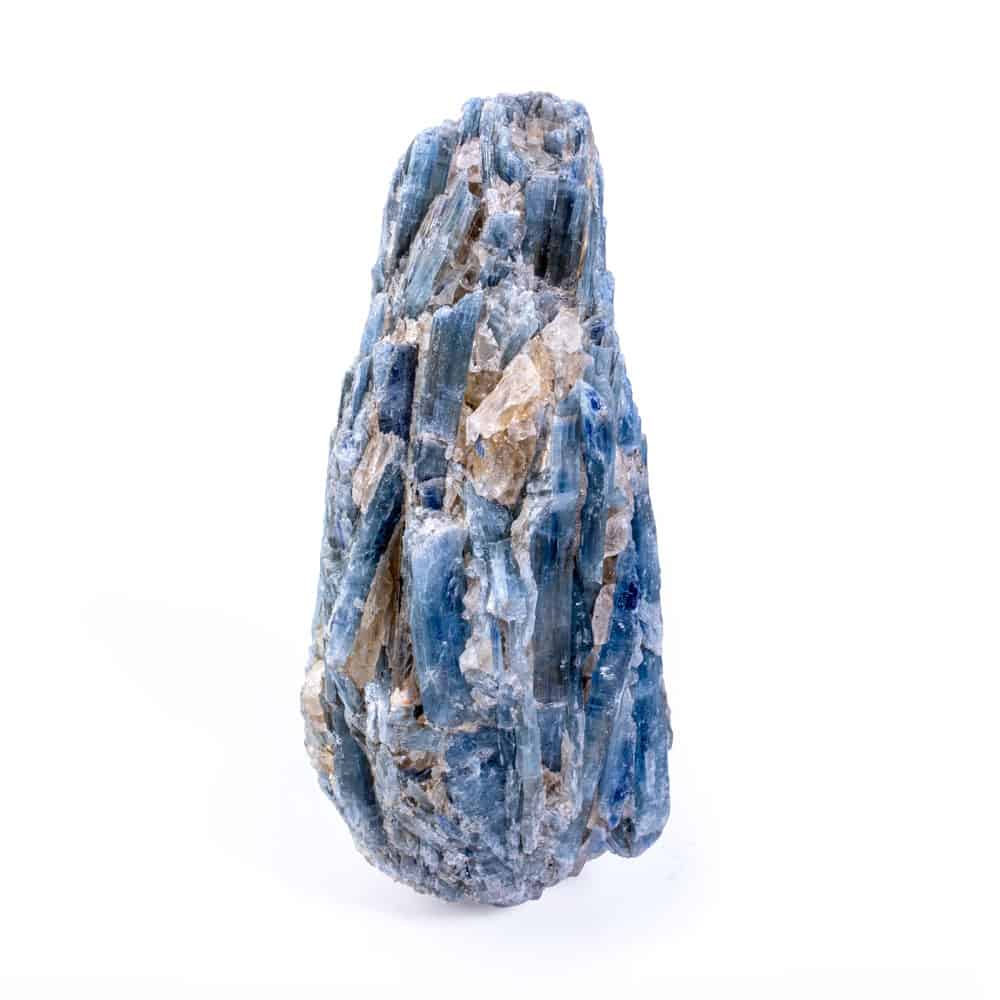
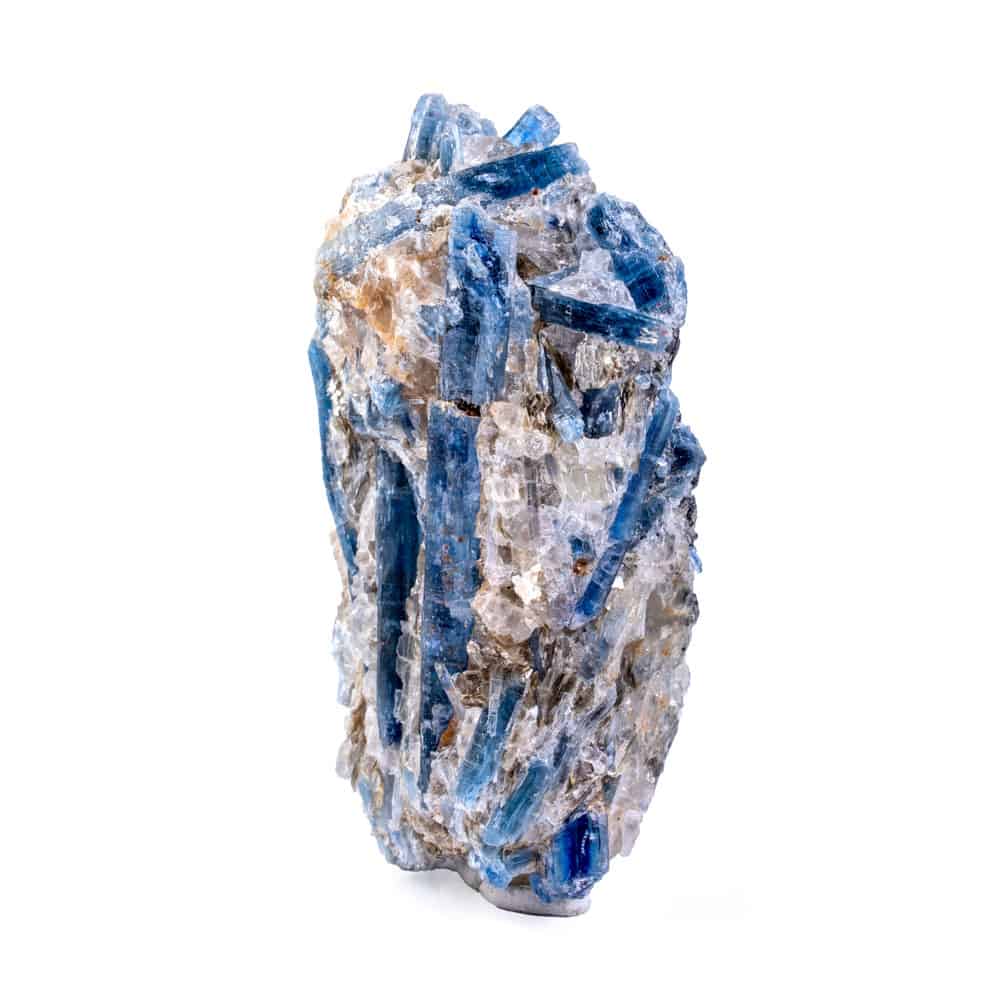
| Crystal Habit | Blade-like, elongated; columnar aggregates |
| Colour | Blue (most common), black, green, orange, colourless, grey |
| Hardness (Mohs) | 4.5–5 (parallel to length) / 6.5–7 (perpendicular) |
| Specific Gravity | 3.53–3.67 |
| Lustre | Vitreous to pearly |
| Transparency | Transparent to translucent |
| Cleavage | Perfect in two directions |
| Named By | Abraham Gottlob Werner, 1789 |
| Etymology | Greek kyanos — blue |
| Also Known As | Disthene, cyanite |
| Polymorphs | Andalusite, sillimanite |
| Primary Sources | Brazil, Nepal, Tibet, USA, Kenya, Tanzania |
| Chakra Associations | Throat (blue), Root (black), Heart (green) |
| Zodiac | Aries, Taurus, Libra |
| Typical Uses | Collector specimens, jewellery, ceramics, refractories, meditation |
What Is Kyanite?
Kyanite is an aluminium silicate mineral with the chemical formula Al₂SiO₅, forming elongated, blade-like crystals in metamorphic rocks subjected to high pressures during tectonic activity. It belongs to the nesosilicate subgroup and crystallises in the triclinic system — one of only a handful of common minerals to do so. The result is a low-symmetry crystal that contributes directly to kyanite’s most celebrated physical characteristic: hardness that changes depending on which direction you scratch it.
Most commonly encountered as blue, kyanite also occurs in black, green, orange, and, rarely, colourless forms, each the product of different trace-element chemistries. Fine gem-quality material — particularly deep-blue blades from Nepal and Tibet, or vivid orange crystals from Tanzania — commands genuine collector attention. Beyond the collector market, kyanite is a significant industrial mineral, used in the production of high-temperature ceramics, spark plugs, furnace bricks, and abrasive materials.
The stone sits at the intersection of rigorous mineralogy and expansive metaphysical tradition. Its blade-like form, its directional properties, and its quietly striking colour have made it a fixture in both serious mineral collections and crystal-healing practice for generations.
Kyanite Name, History, and Lore
Where does the name “kyanite” come from?
Kyanite was named in 1789 by German geologist Abraham Gottlob Werner, who derived the name from the Greek word kyanos, meaning blue. Werner was one of the most influential mineralogists of the eighteenth century — his descriptive system for minerals formed the foundation of modern mineralogy — and kyanite was among the many specimens he formally characterised and named.
Two significant alternative names have also known the mineral:
- Disthene — from the Greek dis (two) and sthenos (strength), a direct reference to its dual hardness. This name was widely used in European mineralogical literature through the nineteenth and early twentieth centuries and remains in use in some French and German scientific texts today.
- Cyanite — an older anglicised spelling, now largely obsolete, though it still appears in historical texts and the occasional trade context.
Historical and cultural context
Kyanite does not carry the dense mythological history of stones such as lapis lazuli or emerald — it was not a gem of ancient courts or a fixture of religious iconography. Its use as a lapidary material and collector’s stone developed primarily from the eighteenth century onwards, as the discipline of systematic mineralogy expanded and blade crystals from Alpine schists and, later, Brazilian pegmatites reached European collections.
By the twentieth century, kyanite had found a second life in industry, where its exceptional thermal stability proved commercially significant. In parallel, it entered the crystal-healing lexicon, where its bladed form and blue colouration connected it symbolically to clarity, communication, and the cutting through of confusion.


Kyanite Mineralogy and Physical Properties
What are the physical properties of kyanite?
Kyanite’s mineralogy is defined by a set of properties that make it genuinely distinctive — not just among collector minerals, but within mineralogy broadly. Physical properties at a glance:
- Crystal system: Triclinic
- Crystal habit: Elongated blades, often striated along their length; occasionally columnar or radiating aggregates.
- Hardness: 4.5–5 (parallel to crystal length) / 6.5–7 (perpendicular to crystal length)
- Specific gravity: 3.53–3.67
- Lustre: Vitreous to pearly, especially on cleavage surfaces
- Transparency: Transparent to translucent
- Cleavage: Perfect in one direction (parallel to the blade), good in a second
- Fracture: Splintery
- Streak: White
- Colour: Blue, black, green, orange, grey, colourless
Blue is the most familiar colour, caused by Fe(II)–Fe(III) charge transfer between iron atoms in adjacent structural sites. The intensity varies considerably — from pale, almost grey-blue through to a deep, saturated indigo — and zoning within a single crystal is common, producing bands of stronger and weaker colour along the blade’s length.
How does kyanite form?
Kyanite forms during regional metamorphism under conditions of elevated pressure and relatively moderate temperatures — typically in what geologists call the blueschist-to-eclogite facies. These conditions occur where tectonic plates converge,e and rock is forced to depth without being heated rapidly.
As aluminium-rich source rocks (typically pelitic schists — metamorphosed mudstones and shales) are subjected to increasing pressure, their mineralogy reorganises. At the pressure and temperature conditions where kyanite is stable, the aluminium silicate component crystallises in the kyanite structure rather than as andalusite or sillimanite. This makes kyanite a reliable indicator of high-pressure metamorphic conditions — a so-called index mineral used by geologists to reconstruct the burial history of mountain belts.
Where is kyanite found?
Kyanite occurs in metamorphic terrains worldwide. The most significant sources for collector-quality material include:
- Nepal and Tibet — outstanding blue blade crystals, often with strong colour and good transparency
- Brazil — a major source for both gem-quality and industrial kyanite
- Kenya and Tanzania — sources of blue and, notably, orange kyanite
- United States — historically significant deposits in North Carolina, Virginia, and Georgia; the US remains a major industrial producer
- Switzerland and Austria — classic Alpine occurrences in eclogites and schists, prized by European collectors
- Zimbabwe (Karoi) — notable for its rich blue colour, often with strong tonal depth, giving the material a more saturated and visually weighty appearance.
Kyanite's Unusual Hardness: Why It Varies by Direction
Why does kyanite have two different hardness values?
Kyanite's most discussed physical property — and the one that distinguishes it most sharply from other minerals — is its anisotropic hardness: the fact that its resistance to scratching differs depending on the direction of the scratch.
Tested parallel to the length of the blade (along the c-axis), kyanite measures 4.5–5 on the Mohs scale. Tested perpendicular to that axis — across the width of the blade — it measures 6.5–7. This is not a minor variation. A scratch that slides easily along a kyanite blade will meet significantly greater resistance when drawn across it.
This property results from kyanite's triclinic crystal structure. The Al–O and Si–O bond arrangements within the structure differ in strength depending on the crystallographic direction, so resistance to mechanical disruption — what the Mohs scale actually measures — varies accordingly.
The name disthene (two strengths) directly references this property. It also has practical implications. Kyanite is notoriously difficult to facet for jewellery use because the lapidary must account for directional hardness, cleavage, and brittleness simultaneously. Well-executed kyanite gems represent genuinely skilled work.
For those drawn to the stone for its collector or metaphysical qualities rather than its wearability, this property adds a layer of character. Kyanite behaves differently depending on how you engage with it — a quality that practitioners within the crystal-healing tradition find symbolically apt.
Kyanite, Andalusite, and Sillimanite: The Al₂SiO₅ Polymorphs
What is the relationship between kyanite, andalusite, and sillimanite?
Kyanite, andalusite, and sillimanite are polymorphs — three minerals with identical chemical formulas (Al₂SiO₅) but different crystal structures, each stable under a distinct set of pressure and temperature conditions. This makes the Al₂SiO₅ system one of the most useful geothermometers and geobarometers available to metamorphic petrologists.
| Property | Kyanite | Andalusite | Sillimanite |
|---|---|---|---|
| Chemical formula | Al₂SiO₅ | Al₂SiO₅ | Al₂SiO₅ |
| Crystal system | Triclinic | Orthorhombic | Orthorhombic |
| Stable conditions | High pressure, moderate temperature | Low pressure, low–moderate temperature | Low–moderate pressure, high temperature |
| Typical setting | Blueschist/eclogite facies metamorphism | Contact or low-grade regional metamorphism | High-grade regional metamorphism |
| Hardness (Mohs) | 4.5–7 (anisotropic) | 6.5–7.5 | 6.5–7.5 |
| Specific gravity | 3.53–3.67 | 3.13–3.16 | 3.23–3.27 |
| Typical crystal habit | Bladed, elongated | Columnar, prismatic | Fibrous, silky (fibrolite) |
| Collector appeal | High | Moderate–high | Lower; often fibrous |
Of the three, kyanite forms under the highest pressures, making it the most geologically dramatic. Finding kyanite in a rock sample tells a geologist that the rock was once buried to significant crustal depth — and then, through tectonic forces, returned to the surface. That journey is written into every blade.
For collectors, kyanite's larger, more visually striking crystals give it an aesthetic edge over sillimanite (which often occurs as fine fibres) and place it in close competition with better-known andalusite varieties such as chiastolite. The fact that these three minerals are chemically identical yet structurally distinct is part of what makes them compelling to anyone who pays attention to what rocks actually record.
Kyanite Meaning and Symbolism
The associations below reflect kyanite's place within crystal-healing tradition and metaphysical practice. They represent matters of personal belief and cultural symbolism, not scientific claims.
What does kyanite mean in crystal-healing tradition?
Kyanite is regarded in crystal-healing tradition as a stone of clarity and alignment. Its blade-like form — sharp, directed, purposeful — gives it a symbolic quality that most rounded or tumbled stones lack. Practitioners connect it with the capacity to cut through confusion, communicate with precision, and bring scattered energies into coherent focus.
Unlike many stones said to accumulate or hold energy, kyanite is traditionally regarded as self-cleansing — one of very few crystals held not to require regular energetic clearing. This quality has contributed to its reputation as a quietly reliable companion stone: one that maintains its own integrity without demanding attention.
Symbolically, kyanite is most strongly associated with:
- Clarity of thought and communication — the ability to articulate what one means without distortion or fear
- Alignment — bringing disparate parts of oneself, a situation, or a relationship into coherent order
- Truth-telling — the courage to speak honestly, including to oneself
- Calm decisiveness — action that comes from a clear mind rather than reactive emotion
- Integrity — consistency between inner values and outward expression
Emotional and Spiritual Associations of Kyanite
What are the emotional associations of kyanite?
Within crystal-healing tradition, kyanite is associated with navigating periods of complexity, confusion, or conflict with composure. Where some stones are described as emotionally warming or activating, kyanite's quality is more often characterised as clarifying — like light falling into a previously dim space.
Practitioners connect kyanite with:
- Mental calm — quietening the noise of overthinking to access clearer perception
- Honest communication — both in speaking to others and in acknowledging one's own interior landscape
- Emotional resilience — the capacity to remain centred under pressure without suppressing feeling
- Conflict resolution — an orientation toward understanding rather than reactivity in difficult interpersonal situations
- Alignment between thought and action — reducing the gap between what one knows to be true and what one actually does
What are the spiritual associations of kyanite?
Spiritually, kyanite is associated with:
- Meditation and inner stillness — its blade-like form makes it a natural companion for focused, directed meditation practice
- Dream recall and lucid dreaming — blue kyanite in particular is cited in many traditions as supportive of conscious awareness during sleep states
- Energetic alignment — the metaphysical counterpart to its geological identity as an index mineral
- Psychic clarity — supporting discernment in intuitive perception, helping to distinguish genuine insight from projection
Chakras, Zodiac, and Energetic Correspondences
What chakra is kyanite associated with?
Kyanite's chakra associations vary by colour, making it one of the more versatile stones in crystal-healing tradition from an energetic standpoint.
Blue kyanite is most strongly linked to the Throat Chakra (Vishuddha) — the centre of communication, authentic self-expression, and the courage to speak one's truth. Its secondary association is with the Third Eye Chakra (Ajna), which connects it to clarity of perception, inner vision, and the quieting of mental distraction.
Black kyanite is associated with the Root Chakra (Muladhara), where it is said to support grounding, protection, and the clearing of stagnant or dissonant energy from the energetic field.
Green kyanite is linked to the Heart Chakra (Anahata), symbolising emotional openness, compassion, and attunement with the natural world.
Zodiac associations: Kyanite is most commonly connected with Aries, Taurus, and Libra. The Aries connection reflects its clarity and directness; the Taurus link its grounding stability; and the Libra association its capacity for balance and considered communication.
The Different Types of Kyanite
What are the different varieties of kyanite?
Kyanite occurs in a broader range of colours than many people realise. Each variety has its own geological origin and, within crystal-healing tradition, its own distinct character.
Blue Kyanite
Blue kyanite is the most familiar and widely collected variety — what most people mean when they refer simply to kyanite. Its blue colour results from Fe(II)–Fe(III) charge transfer, a mechanism in which electrons move between iron atoms in different oxidation states within the crystal structure, thereby absorbing specific wavelengths of light.
The blue ranges from a pale, watery sky-blue through to deep, vivid indigo. Colour zoning is common, and many crystals show a gradient of intensity along the blade — darker at the centre, paler toward the edges, or banded in alternating light and deep zones. Fine blue kyanite from Nepal and Tibet represents some of the most visually striking blade crystals in the mineral kingdom.
Black Kyanite
Black kyanite forms fan-like or sheaf-like aggregates of blades, often with a distinctly earthy, grounding visual presence. The dark colouration results from inclusions of graphite and other opaque minerals within the crystal, rather than from any single colouring agent.
Black kyanite is widely used in crystal-healing practice, where its form — radiating outward like a protective fan — is symbolically associated with energetic shielding and clearing unwanted or heavy energy. It is associated with the Root Chakra and is regarded as one of the more strongly grounding stones available. Black kyanite meaning in metaphysical tradition centres on protection, clearing, and the stabilisation of one's energetic foundation.
Green Kyanite
Green kyanite is less common than blue or black, occurring in pale to medium green blades with a soft, restful quality. The green colour is generally attributed to iron in a different structural configuration than that responsible for blue colouration, though the precise mechanism can vary by locality.
Green kyanite is associated with the Heart Chakra in crystal-healing tradition, connecting it to growth, compassion, and alignment with the natural world. Its quieter, less immediately dramatic appearance makes it a favourite among those who seek subtlety in their collections.
Orange Kyanite
Orange kyanite is the rarest of the widely recognised varieties, found primarily in Tanzania. The orange colour — ranging from a warm peachy tone through to a rich, saturated amber — is caused by the substitution of Mn³⁺ (manganese in the +3 oxidation state) into the crystal structure, a colouring mechanism quite different from that responsible for the blue.
Faceted orange kyanite from Tanzania is genuinely scarce and commands collector premiums accordingly. Its warmth and rarity make it a compelling addition to any serious mineral or gem collection.
Ruby in Kyanite
Ruby in kyanite is not a single mineral but a natural combination stone — typically a matrix of blue kyanite host with inclusions or intergrowths of red corundum (ruby). This combination occurs primarily in India, where metamorphic conditions have produced both minerals in close association.
The visual contrast — deep blue blades set against ruby red — makes this one of the more dramatic combination minerals available. Ruby in kyanite, in metaphysical tradition, draws on both components: the clarity and communication of kyanite, combined with the vitality and courage associated with ruby. It is linked to both the Throat and Root Chakras, and is regarded as a stone for those navigating situations that call for both grounded determination and clear expression.
How to Use Kyanite
Kyanite's combination of visual character, geological significance, and metaphysical tradition gives it genuine versatility. It suits multiple contexts and modes of engagement.
As a collector specimen
For serious mineral collectors, kyanite is a category staple. Fine blade crystals — particularly those with deep, even blue colouration, strong vitreous lustre, and minimal damage to terminations — from Nepal, Tibet, or classic Alpine localities represent some of the finest metamorphic mineral aesthetics available. Displayed thoughtfully, a well-chosen kyanite blade needs nothing around it to command attention. Orange kyanite crystals from Tanzania occupy a distinct collector niche: genuinely rare, gem-quality material that few collections include.
In jewellery
Kyanite's anisotropic hardness and perfect cleavage make it a challenging but rewarding material for lapidary work. Well-executed faceted blue kyanite — particularly stones cut to account for colour zoning and directional properties — can produce gems of genuine beauty, with a depth of blue that rivals more expensive alternatives. Given the skill required to facet it well, quality kyanite jewellery carries both aesthetic and craft value.
In meditation and ritual practice
Those drawn to kyanite's metaphysical qualities often work with it during meditation, holding a blade in the non-dominant hand or placing it at the throat. Blue kyanite's traditional associations with clarity and communication make it a natural companion for practices focused on truthful self-examination, creative articulation, or simply quietening a busy mind. Black kyanite, with its fan-like form and grounding associations, is often placed at the base of the spine or swept lightly across the energetic field.
In décor and as a talisman
Kyanite blades make striking objects on a collector's shelf, a writing desk, or within a curated mineral arrangement. Their directional form gives them an architectural quality that few tumbled or rounded stones can match. As a personal talisman, kyanite — particularly blue or black — is chosen by those who value its associations with clarity, alignment, and honest communication.
Caring for and Cleansing Kyanite
How should you physically care for kyanite?
Kyanite's physical care requires attention to two specific vulnerabilities: its anisotropic hardness and its perfect cleavage. Along the blade, kyanite scratches relatively easily (4.5–5 Mohs); it is also susceptible to cleavage when subjected to sharp impacts. Handle blade crystals with care, and avoid dropping them onto hard surfaces.
Cleaning:
- Use warm water and a mild soap with a soft brush or cloth
- Rinse thoroughly and allow to dry naturally
- Avoid ultrasonic cleaners — the vibration can stress cleavage planes and cause fracturing
- Steam cleaning is not recommended
- Keep away from harsh chemicals and acidic substances
Storage:
- Store kyanite away from harder minerals that could scratch the blade surface — quartz points, topaz, and beryl, for example
- Wrap specimens individually in soft cloth or store in a padded compartment
- Keep blades horizontal where possible to avoid stress on thinner crystals
Kyanite is safe for brief contact with water during cleaning. Prolonged immersion is not recommended.
How should you cleanse kyanite energetically?
Kyanite is one of the minerals traditionally regarded as self-cleansing in crystal-healing practice — meaning it is said not to accumulate and hold energy in the way many other stones are described as doing. Many practitioners therefore actively use kyanite to cleanse other crystals, drawing its blades lightly over or around them.
That said, if periodic energetic refreshing feels right:
- Moonlight — placing kyanite under a full or waxing moon overnight is one of the gentlest and most widely practised methods
- Sound — a singing bowl, tuning fork, or bells can bathe the stone in resonant vibration without physical risk to its structure.
- Smoke — passing the stone briefly through sustainably sourced sage, palo santo, or incense smoke
- Sunlight — brief exposure is generally safe, though extended direct sunlight may affect colour in some specimens over time
Avoid salt cleansing methods, which can scratch the surface and, if wet salt is used, may penetrate along cleavage planes.
Frequently Asked Questions
What is kyanite?
Kyanite is an aluminium silicate mineral (Al₂SiO₅) that forms in high-pressure metamorphic rocks. It is characterised by its elongated, blade-like crystals, its variable Mohs hardness (4.5–5 parallel to the blade, 6.5–7 perpendicular), and its most common blue colour. Kyanite occurs worldwide and is valued by mineral collectors, lapidaries, crystal enthusiasts, and the ceramics industry.
What is kyanite's hardness, and why does it vary?
Kyanite has a Mohs hardness of 4.5–5 when scratched parallel to the blade’s length, and 6.5–7 when scratched across it. This directional variation is called anisotropism and results from the asymmetric arrangement of bonds in kyanite’s triclinic crystal structure. It is one of the defining mineralogical characteristics of the species and is referenced in its alternative name, disthene, meaning “two strengths.”
What causes the blue colour in kyanite?
The blue colour in kyanite results from Fe(II)–Fe(III) charge transfer — a process in which electrons move between iron atoms in different oxidation states within the crystal structure. This mechanism absorbs specific wavelengths of light, producing the blue that ranges from pale sky-blue to deep indigo. Colour zoning within individual crystals is common.
What is the difference between kyanite, andalusite, and sillimanite?
All three minerals share the chemical formula Al₂SiO₅ but have different crystal structures — they are polymorphs. Kyanite forms under high pressure; andalusite under low pressure and low to moderate temperature; sillimanite at high temperature. Each serves as an index mineral for metamorphic petrologists studying the pressure-temperature history of rocks.
What are the different colours of kyanite?
Kyanite occurs in blue (most common, caused by Fe(II)–Fe(III) charge transfer), black (caused by graphite and opaque inclusions), green (iron-related colouration), orange (caused by Mn³⁺ substitution, found primarily in Tanzania), and rarely colourless or grey. Ruby in kyanite is a natural combination stone featuring kyanite alongside red corundum.
What chakra is kyanite associated with?
Chakra associations vary by colour. Blue kyanite is primarily linked to the Throat Chakra (Vishuddha), which governs communication and authentic expression, with a secondary association with the Third Eye. Black kyanite is connected to the Root Chakra. Green kyanite aligns with the Heart Chakra. These associations are held within crystal-healing tradition and represent matters of personal belief.
Final Thoughts On Kyanite
Kyanite brings together the qualities that make a mineral worth returning to: distinctive structure, geological significance, and unmistakable visual presence. Its blade-like crystals, variable hardness, and high-pressure origins set it apart scientifically. At the same time, its rich colour range gives it lasting appeal for collectors and those drawn to natural stone more broadly. Whether considered through the lens of mineralogy, symbolism, or provenance, kyanite remains a stone with clarity, character, and depth.