



Lepidolite Meaning: Healing Properties, Mineralogy & Uses
TL;DR
Lepidolite — K(Li, Al)₃(Al, Si)₄O₁₀(F, OH)₂ — is apotassium-lithium-aluminiumm phyllosilicate of the mica group. It forms through late-stage magmatic crystallisation within granitic pegmatites, most often alongside other lithium-bearing minerals. Mohs hardness ranges from 2.5 to 4 — notably soft. Its characteristic lavender, pink, and violet tones are produced by trace manganese. In crystal-healing tradition, lepidolite is known as a stone of transition and emotional calm, associated with the Heart, Third Eye, and Crown Chakras, the zodiac sign Libra, and the element Water. It is moisture-sensitive and should not be submerged.
Lepidolite is a lithium-bearing mica mineral with a colour range spanning soft lavender to deep violet-pink — and a story that begins not in the world of crystals, but deep within granitic pegmatites millions of years in the making. This guide covers everything worth knowing: the geology and mineralogical identity of lepidolite, where it forms and how it is found, its visual character across all its varieties, and its rich tradition of meaning and metaphysical association. It also covers how to use lepidolite responsibly, how to care for it at home, and what to know before placing it near water.
Lepidolite at a Glance
| Property | Detail |
|---|---|
| Chemical Formula | K(Li,Al)₃(Al,Si)₄O₁₀(F,OH)₂ |
| Mineral Group | Mica group, phyllosilicates |
| Crystal System | Monoclinic |
| Crystal Habit | Tabular, short prismatic, scaly aggregates, massive; rarely well-formed individual crystals |
| Colour | Lilac, pink, violet, rose-red; less commonly colourless, grey, or yellow |
| Hardness (Mohs) | 2.5–4 |
| Specific Gravity | 2.8–3.1 |
| Lustre | Vitreous to pearly |
| Streak | White to colourless |
| Transparency | Transparent to translucent |
| Cleavage | Perfect basal in one direction |
| Fracture | Uneven |
| Luminescence | Fluoresces orange-yellow under UV light |
| Named By | Martin Klaproth, 18th century |
| Etymology | Greek lepidos — scale (referring to its scaly, mica-like texture) |
| Also Known As | "Peace Stone," "Grandmother Stone," "Stone of Transition" (metaphysical tradition) |
| Primary Sources | Brazil, Russia, Madagascar, Afghanistan, USA (California, New Mexico), Canada, Australia, Czech Republic |
| Chakra Associations | Heart, Third Eye, Crown |
| Zodiac | Libra |
| Element | Water |
| Numerology | 8 |
What Is Lepidolite?
Lepidolite is a potassium-lithium-aluminium phyllosilicate mineral — a member of the mica family — defined by its layered, scaly structure and soft lilac-to-violet colouration. It is one of the primary natural ore minerals for lithium, the soft silvery-white metal now central to rechargeable batteries, glass manufacturing, and aerospace engineering.
The name was formalised by German chemist Martin Klaproth in the 18th century, taken from the Greek lepidos, meaning "scale" — a reference to the mineral's characteristically platy, shimmering habit. Before that, it was called lilalite, a name given by German naturalist Nicolaus Poda von Neuhaus for its soft lavender colour. That original name captures something the mineral's chemistry alone does not: lepidolite is, visually, one of the most quietly beautiful members of the mica group.
In its natural geological setting, lepidolite occurs alongside other lithium-bearing minerals — tourmaline, spodumene, amazonite, moonstone — in granitic pegmatites. This association reflects the complex, late-stage chemistry of cooling magmas enriched in rare elements. Unlike many minerals found across varied geological environments, lepidolite is an almost exclusive inhabitant of pegmatites. That particularity is part of what defines it mineralogically.
One distinction worth making clear: the lithium in lepidolite is locked within its mineral structure. It is not biologically available through casual skin contact. Any calming associations attributed to lepidolite within the crystal-healing tradition are matters of cultural symbolism and personal belief — not pharmacological effects of its lithium content.
Mineralogy and Physical Properties
What are the physical properties of lepidolite?
Lepidolite crystallises in the monoclinic system and belongs to the phyllosilicate mineral group, in which silica tetrahedra are arranged into flat, hexagonal sheets. These layers slide against one another, producing the perfect basal cleavage and characteristic flexibility that define all mica minerals.
Key physical properties:
- Crystal system: Monoclinic
- Crystal habit: Tabular to short prismatic; more commonly in dense, scaly aggregates or massive form
- Hardness: 2.5–4 Mohs — notably soft, close to the hardness of a copper coin
- Specific gravity: 2.8–3.1
- Lustre: Vitreous to pearly
- Streak: White to colourless
- Transparency: Transparent to translucent
- Cleavage: Perfect basal in one direction — characteristic of all micas
- Fracture: Uneven
Lepidolite's colour — its most immediately striking quality — is produced by trace manganese (Mn²⁺) within its crystal structure. This is frequently misunderstood: the colour is a manganese signature, not a lithium one. Colour intensity varies considerably between specimens. Some are a pale, almost chalky lavender; others reach a saturated rose-violet that reads closer to pink in certain light. Colourless and yellowish specimens do exist but are the exception.
Lepidolite often contains quartz inclusions, which add structural resilience and a subtle sparkle to the surface. A well-polished piece catches light in a distinctly mica-like way — a soft, diffused sheen rather than the deep vitreous flash of quartz or amethyst.
How Lepidolite Forms and Where It Is Found
How does lepidolite form?
Lepidolite forms through late-stage magmatic crystallisation within granitic pegmatites — exceptionally coarse-grained igneous rocks that develop from the final, highly enriched fluid phases of cooling granite magmas. As the main body of granite solidifies, elements that do not fit easily into common mineral lattices — including lithium and fluorine — become concentrated in the residual melt. When these enriched fluids crystallise slowly at depth, they produce the mineral assemblages characteristic of lithium pegmatites: lepidolite, pink elbaite tourmaline, spodumene, columbite, and sometimes gem-quality beryl.
Lepidolite typically forms in cavities, fractures, and the core zones of pegmatite bodies, where the most evolved fluids accumulate last. This geological setting explains why lepidolite rarely occurs in isolation — a specimen on matrix is typically accompanied by one or more of its natural companions, and those natural assemblages are among the most sought-after pieces in specialist collecting.
Where is lepidolite found in the world?
Brazil — and Minas Gerais in particular — produces the greatest volume of lepidolite available in the international market, and much of the finest colour material originates there. In the mineral world, "Minas Gerais" on a label carries much the same weight as a named vineyard does for wine.
Lepidolite Colour, Texture, and Common Forms
What does lepidolite look like?
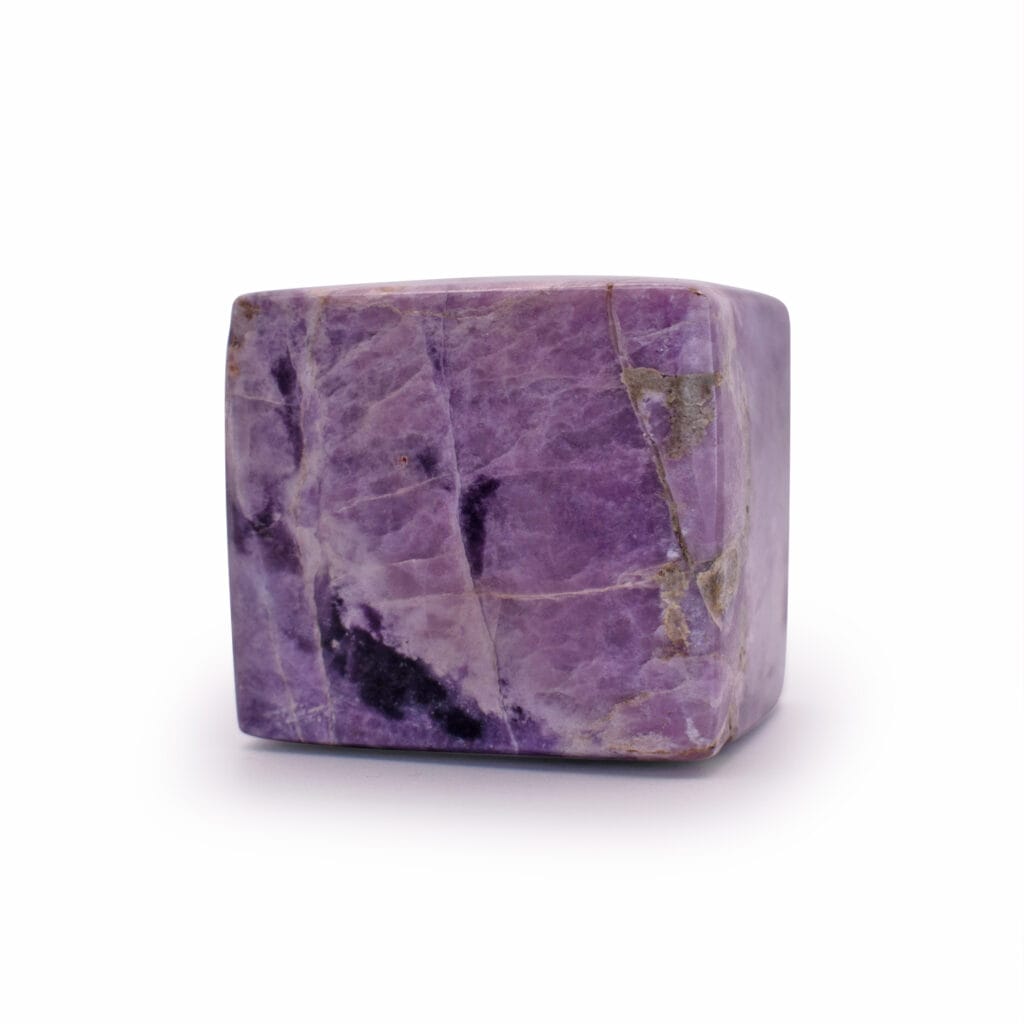
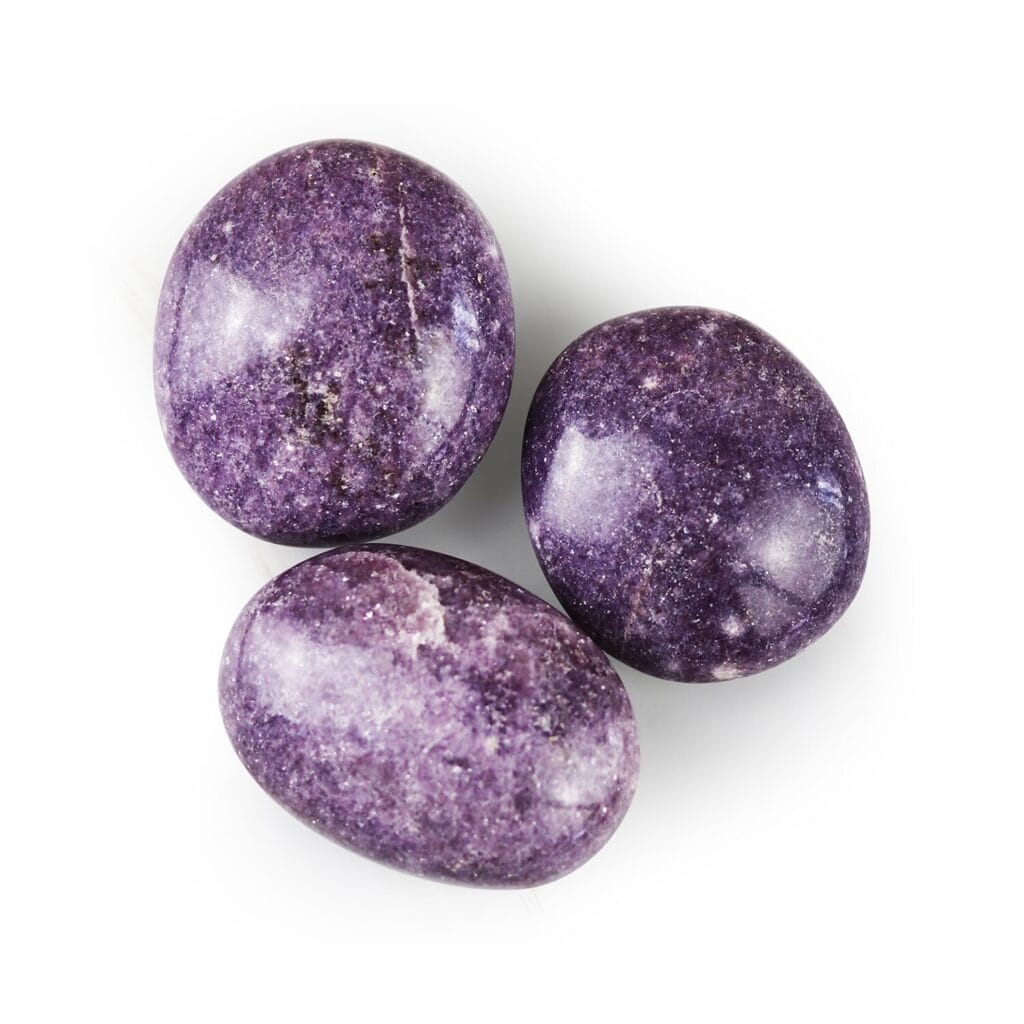
Lepidolite's visual character rests on three qualities: its soft, semi-translucent colour, its layered mica texture, and the shimmer produced by light moving across its platy crystal surfaces.
Colour range: Pale lilac and soft lavender through to deeper violet-pink and rose. The most commercially common tone is a mid-toned purple-lilac; the richest, most saturated specimens attract the greatest collector interest.
Common forms in the market:
- Massive lepidolite: The most widely available form — dense, fine-grained aggregates without defined crystal shape. Cuts and polishes well; used for cabochons, beads, tumbled stones, and carvings.
- Scaly or foliated aggregates: Dense concentrations of small overlapping plates with a characteristic sparkle when polished perpendicular to the layering.
- Lepidolite on matrix: Specimens showing lepidolite in natural association with its host rock and mineral companions — tourmaline, quartz, or albite feldspar. Most prized by collectors for their mineralogical context alongside visual appeal.
- Individual crystals: Tabular to short prismatic forms do occur but are uncommon. Well-formed crystals on matrix from classic localities are genuine rarities.
Lepidolite is sometimes confused with purple fluorite, lavender amethyst, or certain pale kunzite specimens. The distinguishing features are its perfect basal cleavage, pearly rather than vitreous lustre, and notably low hardness — a steel nail (Mohs ~5.5) will scratch it easily, while fluorite requires more pressure.



Lepidolite Meaning and Symbolism
What does lepidolite mean?
Within crystal-healing tradition, lepidolite holds a quiet but consistent reputation as a stone of transition — a mineral for navigating change with steadiness rather than resistance. It goes by several names that reflect this: the "Peace Stone," the "Grandmother Stone," and the "Stone of Transition." Each points to the same core quality: an unhurried, stabilising energy said to support individuals through periods of significant personal change.
Where many crystals are described as activating or amplifying, lepidolite is consistently characterised as steadying. It is associated with the reduction of emotional turbulence, the release of habitual patterns, and the gradual restoration of internal equilibrium — a stone often reached for during grief, upheaval, or any period of extended uncertainty.
Lepidolite is associated with:
- Transition and acceptance — moving through change without forcing a resolution
- Emotional steadiness — a gentle anchor during overwhelm
- Letting go — releasing patterns, relationships, and beliefs that no longer serve
- Inner wisdom — access to intuition unclouded by anxiety
- Calm — peace held from within rather than sought externally
- Nurturing — self-care as a form of quiet spiritual practice
Emotional and Spiritual Associations
What are lepidolite's healing properties in crystal-healing tradition?
Lepidolite's reputation rests on emotional balance and inner clarity. Unlike stones described as intensifying or accelerating spiritual work, lepidolite is framed in tradition as a gentler presence — one that supports the recognition and release of emotional patterns rather than confronting them sharply.
In emotional terms, lepidolite is associated with:
- Releasing behavioural patterns — identifying habitual responses and gradually letting them go
- Reducing overwhelm — a stabilising presence during stress or anxiety
- Encouraging self-responsibility — moving from reactivity to considered response
- Rebuilding emotional resilience — a steady return to inner groundedness
- Self-compassion — kindness toward oneself during difficult transitions
- Restful sleep — traditionally placed near the bed to quieten a busy mind
Spiritually, lepidolite is said to open a channel between the emotional and intuitive dimensions of experience, helping individuals access their own inner knowledge more clearly — cutting through the noise of indecision to reach a calmer, more centred sense of direction.
Chakras, Zodiac, and Crystal Pairings
Which chakra is lepidolite associated with?
Lepidolite's chakra associations span three of the upper energy centres:
- Heart Chakra (Anahata): Associated with love, emotional healing, and compassion. Lepidolite is said to clear blockages that prevent love from flowing freely and to support the integration of difficult emotional experiences.
- Third Eye Chakra (Ajna): Associated with inner wisdom, intuition, and clear perception. Lepidolite is said to quieten anxious thoughts, creating space for intuition to surface.
- Crown Chakra (Sahasrara): Associated with spiritual awareness and a quality of inner stillness and connected with a sense of connection beyond the personal self.
Zodiac: Lepidolite is most strongly connected to Libra — a sign defined by its desire for harmony, balance, and thoughtful decision-making. Some traditions also note associations with Aquarius, Sagittarius, and Capricorn.
Element: Water — reflecting lepidolite's calming, emotionally receptive character.
Numerology: 8 — associated with cycles, balance, and the steady management of change.
Crystal pairings: Lepidolite is often paired with complementary stones:
- Amethyst — deepens Crown Chakra connection; supports meditation and spiritual clarity
- Rose Quartz — amplifies the heart-healing dimension; encourages self-love and compassion
- Black Tourmaline, Hematite, or Obsidian — grounding stones that balance lepidolite's upper-chakra energy
- Blue Lace Agate or Sodalite — supports calm communication; well-suited to anxious states
- Amazonite or Moonstone — geolo
How to Use Lepidolite
Lepidolite's visual beauty and long-established metaphysical reputation make it one of the most versatile minerals in both collector and personal-practice contexts.
As a collector specimen or display piece: Lepidolite on matrix — particularly pieces showing vivid colour alongside tourmaline, quartz, or albite — represents some of the most rewarding work in lithium-pegmatite collecting. A well-chosen specimen transforms any surface it occupies. The soft violet colouration works across a wide range of interior palettes, from neutral and organic to more layered settings. Display lepidolite in good natural or warm artificial light to draw out the quiet shimmer of its mica surfaces.
In jewellery: Lepidolite cabochons in polished massive or foliated form make striking jewellery. Its softness (Mohs 2.5–4) makes it unsuitable for rings subject to daily abrasion, but earrings, pendants, brooches, and bracelets allow its beauty to be worn without risk to the stone. Fine lepidolite set in sterling silver or gold produces jewellery that is quietly arresting — a colour that neither shouts nor retreats. Within crystal-healing tradition, wearing lepidolite is considered the most direct way to maintain a sustained connection with the stone throughout the day.
In meditation and spiritual practice: Those working with lepidolite's metaphysical properties often hold a polished piece during meditation or place it at the heart centre or third eye. Its traditionally calming character suits breath-focused or mindfulness practice particularly well. Placed on a bedside surface, it is said to support a quieter, more settled quality of rest.
In home interiors: Lepidolite suits considered, curated interiors naturally. A polished sphere, freeform, or carved piece brings rare natural beauty to a shelf or desk. Larger raw specimens — particularly those showing the full mineralogical context of their pegmatite origin — make compelling focal points. In Feng Shui, lepidolite is associated with harmonising energy and is placed in spaces where calm and clarity are most needed.
Frequently Asked Questions
What is lepidolite?
Lepidolite is a potassium lithium aluminium phyllosilicate mineral of the mica group, with the chemical formula K(Li,Al)₃(Al,Si)₄O₁₀(F,OH)₂. It forms in granitic pegmatites through late-stage magmatic crystallisation and is one of the primary natural ore sources for lithium.
What gives lepidolite its purple or pink colour?
The characteristic lilac-to-violet colouration of lepidolite is produced by trace amounts of manganese (Mn²⁺) within its crystal structure — not by its lithium content, as is often assumed. Colour intensity varies between specimens, from pale lavender to deep rose-violet.
Does the lithium in lepidolite have any effect on the person holding it?
Lepidolite contains lithium as part of its locked mineral structure. That lithium is chemically bound within the mineral lattice and is not biologically available through skin contact. Any calming properties attributed to lepidolite within crystal-healing tradition are matters of personal belief and cultural symbolism, not pharmacology.
Can lepidolite go in water?
No. Lepidolite should not be placed in water. Its low Mohs hardness makes it susceptible to surface damage with prolonged exposure, and water that has been in contact with lepidolite should not be consumed. For energetic cleansing, smoke smudging, sound cleansing, or placement near selenite are the appropriate methods.
What is the difference between lepidolite and lithium quartz?
Lepidolite is a mica-group mineral with a Mohs hardness of 2.5–4. Lithium quartz is a variety of quartz (SiO₂) containing inclusions of lithium-bearing minerals, with a hardness of 7. The two share a lilac colour range but differ substantially in mineral structure, hardness, and geological origin.
What zodiac sign is lepidolite associated with?
Within crystal-healing tradition, lepidolite is most strongly associated with Libra, reflecting its traditional qualities of balance, harmony, and calm decision-making. Some traditions also connect it to Aquarius, Sagittarius, and Capricorn. These are metaphysical associations, not astrological science.
Where does the best lepidolite come from?
The most commercially significant and collector-quality lepidolite comes from Brazil — particularly Minas Gerais — which produces the greatest volume of vivid, well-formed material in the international market. Russia, Madagascar, Afghanistan, and the United States (California and New Mexico) are also notable sources.
Final Thoughts
Lepidolite offers something few minerals do so naturally: a sense of softness without fragility of meaning. Geologically, it is a remarkable lithium-bearing mica formed in the final, element-rich stages of pegmatite crystallisation. Visually, it brings a quiet shimmer and a palette of lilac, rose, and violet that feels both unusual and immediately calming. And within crystal-healing tradition, it has long been associated with transition, emotional balance, and the steady release of what no longer serves. Whether you are drawn to Lepidolite as a collector, a design-minded admirer of natural materials, or someone exploring its symbolic resonance, it remains one of the most distinctive and quietly compelling stones to live with.