


TL;DR
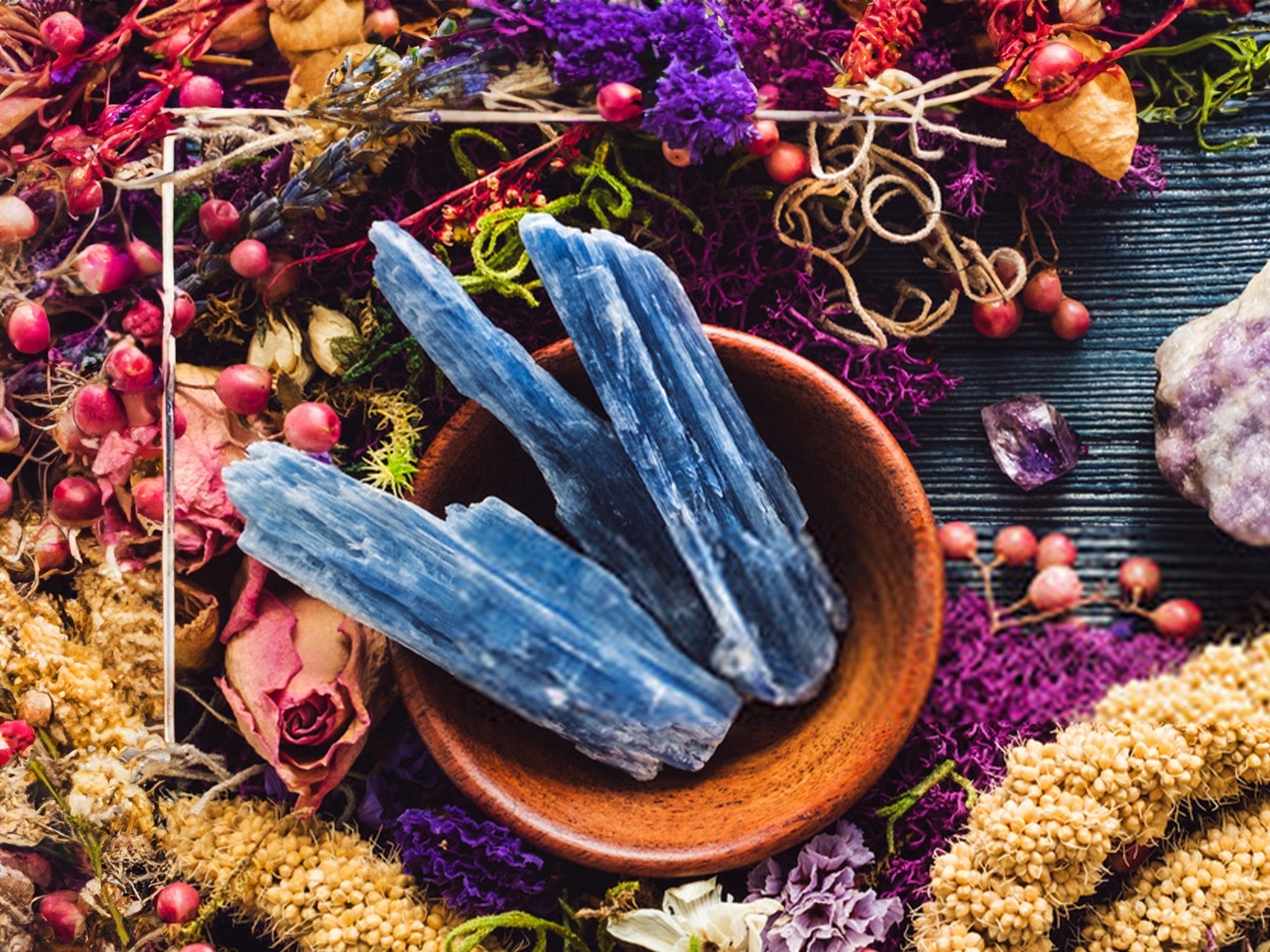
Blue kyanite is a bladed aluminium silicate mineral (Al₂SiO₅) distinguished by its anisotropic hardness — measuring 4.5 along its blade length and up to 7 across the width — and by its deep, striated blue colour caused by trace iron and titanium. Within crystal-healing tradition, it is associated with the Throat and Third Eye Chakras, and is widely valued for supporting clear communication, mental alignment, and intuition.
Uniquely among crystals, blue kyanite is considered self-cleansing in metaphysical practice, meaning most practitioners do not cleanse it at all. For physical care, brief water rinsing is tolerable, but prolonged soaking and salt water should always be avoided.
Blue kyanite is one of mineralogy's most quietly remarkable stones — a bladed aluminium silicate prized for its striking colour and, uniquely, for a property no other common crystal shares: its hardness changes depending on which direction you measure it. This guide covers everything worth knowing about blue kyanite, from its geological identity, anisotropic hardness, and global origins to its spiritual meaning, metaphysical properties, chakra associations, and care. It also answers one of the most widely searched questions about this mineral: whether blue kyanite needs to be cleansed.
Blue Kyanite at a Glance
| Property | Detail |
|---|---|
| Mineral Group | Silicate (nesosilicate / aluminosilicate) |
| Chemical Formula | Al₂SiO₅ |
| Crystal System | Triclinic |
| Hardness (Mohs) | ~4.5 along the blade length; up to 7 across the width |
| Specific Gravity | 3.56–3.67 |
| Lustre | Vitreous to pearly |
| Colour (Blue Variety) | Pale sky blue through to deep cornflower and indigo; often with white or grey striations |
| Transparency | Translucent to transparent in gem-quality specimens |
| Cleavage | Perfect in one direction; imperfect in a second |
| Crystal Habit | Typically bladed or columnar aggregates |
| Also Known As | Disthene, rhaeticite, cyanite |
| Primary Sources | Brazil, Nepal, Tibet, Myanmar, USA (North Carolina), Kenya, Austria |
| Chakra Associations | Throat Chakra (Vishuddha), Third Eye Chakra (Ajna) |
| Zodiac | Aries, Taurus, Libra (varies by tradition) |
| Element | Air, Water |
| Numerology | 4 |
What Is Blue Kyanite? Mineralogy and Identity
Blue kyanite is a naturally occurring aluminium silicate mineral with the chemical formula Al₂SiO₅. It belongs to the triclinic crystal system and typically forms elongated, bladed crystals—flat, striated structures that grow in fan-like or columnar aggregates within metamorphic and sedimentary rocks.
The name kyanite comes from the Greek kyanos, meaning blue or dark blue, a fitting etymology for a stone whose most celebrated variety displays colours ranging from pale sky blue to deep, saturated cornflower and indigo. Kyanite is also known in older literature as disthene (from the Greek for "two strengths"), a name that points directly to its most scientifically distinctive quality: variable hardness.
Kyanite belongs to a trio of aluminium silicate polymorphs — minerals that share the same chemical composition but crystallise in different structures. The other two are andalusite and sillimanite. All three form under different conditions of heat and pressure within metamorphic terranes, making kyanite a useful geological indicator of the conditions under which its host rock was formed.
What Are the Different Colours of Kyanite?
While blue is by far the most recognised variety, kyanite colours span a broader spectrum:
- Blue kyanite — the most common and widely traded variety; colours range from pale, almost grey-blue through to rich indigo
- Black kyanite — formed with inclusions of other minerals; associated in metaphysical tradition with grounding and protection
- Green kyanite — less common; linked in crystal-healing tradition to the Heart Chakra
- Orange kyanite — rarer; found most notably in Tanzania
- Grey and white kyanite — lower iron content produces these paler, quieter variants
Each variety carries its own metaphysical associations, but blue kyanite remains the most widely sought, studied, and collected form.
Blue Kyanite Properties: The Anisotropic Hardness Story
One of the most distinctive blue kyanite properties — and a fact worth understanding clearly — is its variable hardness.
Most minerals have a single Mohs hardness value. Quartz is 7. Feldspar is 6. These numbers apply regardless of which direction you scratch the surface. Blue kyanite behaves differently. Scratch along the length of its blade, and the hardness measures approximately 4.5 on the Mohs scale — soft enough to be marked by a steel nail. Scratch across the width of that same blade, and the hardness rises to approximately 7, comparable to quartz.
This phenomenon is called anisotropic hardness — hardness that varies with direction — and it arises from the crystal's internal structure. Kyanite's aluminium and silicon atoms are bonded together in layers, and the strength of those bonds differs depending on whether you are cutting along the planes or across them. Weaker bonds run parallel to the blade; stronger bonds run perpendicular to it.
This is neither a defect nor a curiosity. It is a fundamental expression of kyanite's crystal structure. The old name disthene — two strengths — was coined precisely to capture this property. It also has real practical implications: kyanite is used industrially in the manufacture of refractory ceramics, spark plugs, and porcelain, where its thermal stability and directional hardness are assets rather than complications.
For anyone working with blue kyanite physically — setting it in jewellery, for example — understanding this dual hardness matters. The long edges of a kyanite blade are softer than the face, which affects both how the stone is cut and how it should be handled.
How Blue Kyanite Forms and Where It Is Found
How Does Blue Kyanite Form Geologically?
Blue kyanite forms through regional metamorphism — the process by which existing rocks are transformed by sustained heat and pressure deep within the Earth's crust. Specifically, kyanite crystallises within the high-pressure, moderate-temperature metamorphic zone, where aluminium-rich sedimentary rocks such as shales and mudstones are subjected to burial and tectonic stress over geological timescales.
The aluminium silicate polymorph that forms — kyanite, andalusite, or sillimanite — depends on the precise pressure and temperature conditions. Kyanite signals high-pressure conditions. Its presence in a metamorphic terrane tells geologists that the rock experienced burial to considerable depths before being exhumed back toward the surface through plate tectonic processes.
The blue colour that characterises the most prized specimens is caused by trace amounts of iron (Fe²⁺/Fe³⁺) and titanium within the crystal structure. Specimens with lower trace element concentrations tend toward grey or white; those richer in iron display the deep, saturated blues most associated with the finest gem and collector material.
Where Is Blue Kyanite Found Around the World?
Blue kyanite is found on multiple continents, with Brazil being the dominant commercial source.
| Location | Notable For |
|---|---|
| Brazil | The world's most significant commercial source; produces high-quality gem-grade blue kyanite across Minas Gerais state |
| Nepal & Tibet | Source of collector-grade specimens with distinctive blade formations |
| Myanmar (Burma) | Produces some of the finest gem-quality blue kyanite, historically significant |
| USA (North Carolina) | One of the first localities described in the scientific literature; still produces quality specimens |
| Kenya & Tanzania | African sources contributing to international supply; Tanzania also produces rare orange kyanite |
| Austria | Historical European locality; significant in the mineralogical record |
| India | Emerging commercial source |
What Does Blue Kyanite Look Like? Colour, Form, and Habit
Blue Kyanite Crystal Appearance
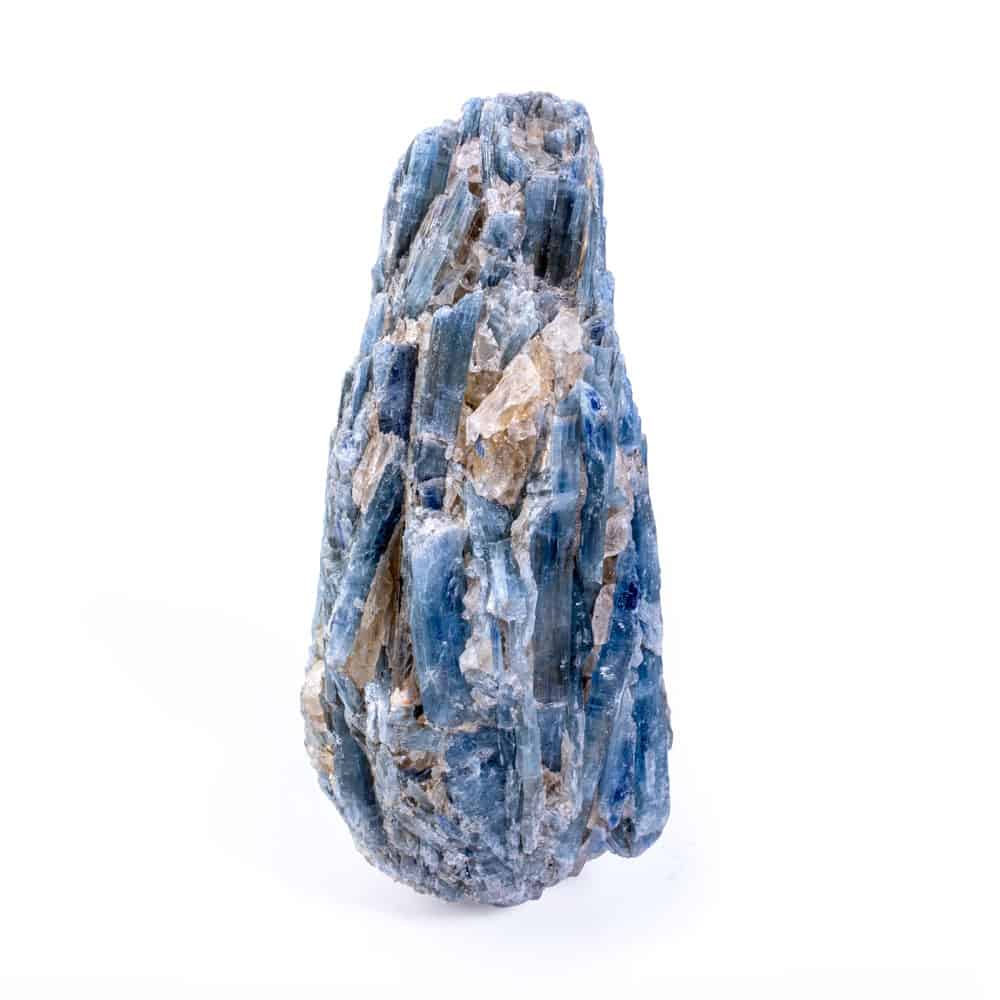
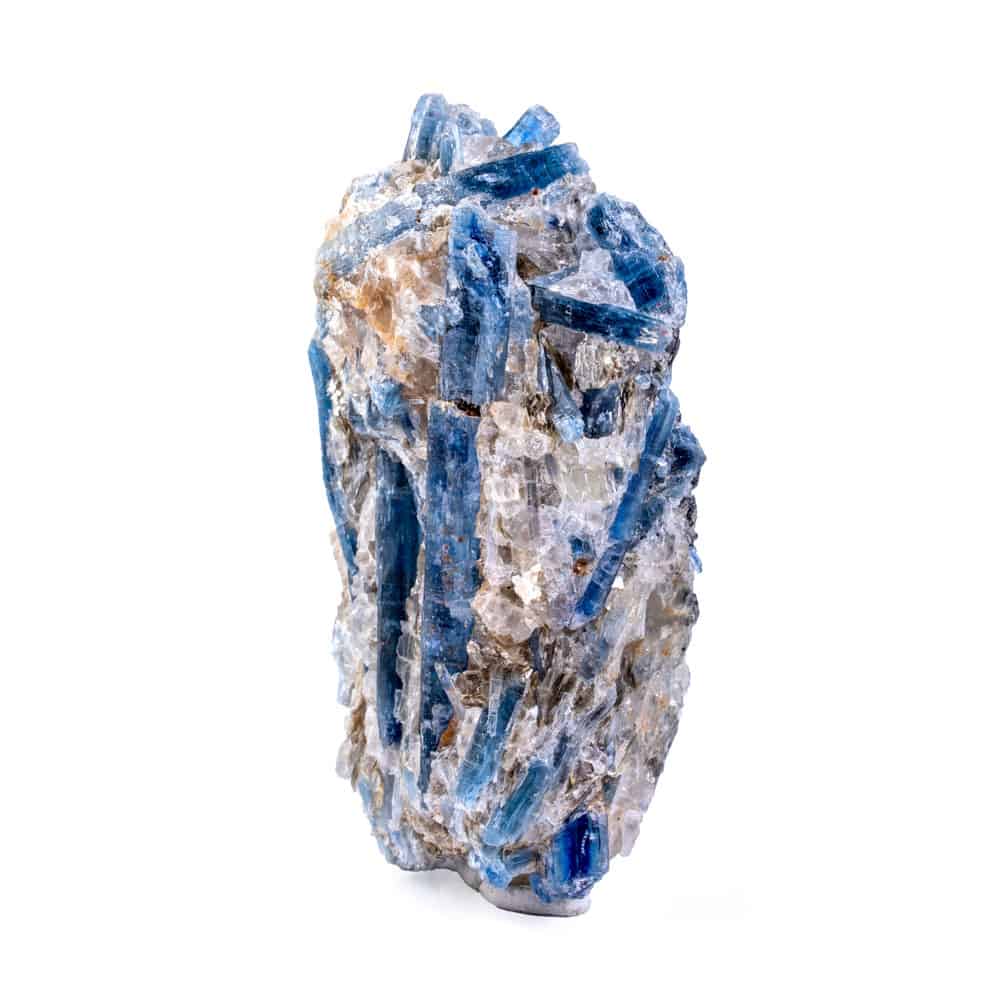
Blue kyanite's visual character is defined by its bladed habit and the characteristic striation lines that run along the length of each crystal. These parallel grooves are not surface damage but an inherent feature of the crystal's growth pattern — an expression of its triclinic structure.
Colour range:
- Pale sky and powder blue — delicate, almost translucent; common in thinner blade specimens
- Mid blue and cornflower — the classic kyanite colour most frequently seen in jewellery
- Deep indigo and sapphire blue — the most prized collector colour; caused by higher iron and titanium content
- Colour zoning — many specimens show colour gradients within a single blade, moving from deep blue at the core to white or grey at the tips or edges.
The bladed habit means that blue kyanite rarely forms a compact, rounded stone. Raw and natural specimens tend to be elongated, with a flat, almost feather-like quality. When light passes through a translucent blade, the colour can appear to shift — a quality that makes fine gem-grade material striking in pendant settings.
Common forms available:
- Raw and natural blades — uncut, showing the mineral's natural habit; favoured by collectors and those who work with the stone energetically
- Tumbled stones — less common than with other minerals, given the blade structure; those that exist tend to be small and irregular
- Cabochons — cut across or along the blade to showcase the colour; used in jewellery
- Faceted gems — rare due to the cleavage and variable hardness; gem-quality faceted kyanite is a specialist collector item
- Carved pieces — freeforms, spheres, and points produced from larger rough material
- Fan or spray specimens — natural specimens showing multiple blades growing from a matrix; among the most aesthetically dramatic forms
Blue Kyanite Meaning and Spiritual Significance
The associations below reflect blue kyanite's established place within crystal-healing tradition and metaphysical practice. They represent matters of personal belief and cultural symbolism, not scientific claims.
What Is the Meaning of Blue Kyanite?
Blue kyanite has a well-established reputation in the crystal-healing tradition as a stone of alignment, clear communication, and truth. Its colour — ranging through the blues most associated with the sky, water, and the spoken voice — has long been connected to the qualities of clarity and honest expression.
The blue kyanite meaning centres on several consistent themes across crystal-healing literature:
- Communication and truth — supporting clear, honest expression and authentic connection
- Alignment — said to bring the subtle energy centres into balance without requiring external assistance; the basis of the widely held belief that blue kyanite does not need cleansing.
- Mental clarity — associated with cutting through confusion, accessing intuition, and seeing situations with greater precision
- Peaceful transition — regarded as a stone that eases change and helps navigate difficult conversations or decisions
- Connection — particularly the connection between the Throat and Third Eye Chakras, linking what is thought with what is said
Blue kyanite spiritual meaning, across the traditions in which it appears, tends to emphasise effortless alignment rather than effortful clearing. This quality distinguishes it from many other stones in metaphysical practice.



Blue Kyanite Benefits: Emotional and Spiritual Associations
Within crystal-healing tradition, the benefits of blue kyanite are understood to mirror its geological character: a stone that maintains its structure regardless of external pressure and does not readily absorb what surrounds it.
Key emotional and spiritual benefits attributed to blue kyanite in these traditions include:
- Clarity in conflict — supporting honest, productive communication in difficult relationships or situations
- Calming mental activity — associated with quieting an overactive mind and reducing anxiety-driven thinking
- Amplifying intuition — particularly linked to the development of inner knowing and the ability to trust one's own perception.
- Dream work — some traditions place blue kyanite near the bed or under the pillow to support vivid, lucid, or revealing dreams.s
- Energetic boundary-setting — regarded as a tool for maintaining personal clarity without becoming emotionally reactive
These associations are held sincerely within crystal-healing communities and deserve thoughtful acknowledgement — alongside clear understanding that they represent spiritual and personal belief, not medical or psychological treatment.
Blue Kyanite Chakra, Zodiac, and Crystal Pairings
What Chakra Is Blue Kyanite Associated With?
Blue kyanite is primarily associated with the Throat Chakra (Vishuddha) — the energy centre located at the throat, connected to communication, self-expression, truth, and the relationship between thought and spoken word. Blue kyanite is said to open and align the Throat Chakra, supporting clear articulation of ideas and authentic expression.
Blue kyanite is also strongly associated with the Third Eye Chakra (Ajna), located at the centre of the forehead. In metaphysical tradition, this centre governs intuition, inner vision, and the capacity to perceive patterns and meaning beyond the surface. Together, the Throat and Third Eye associations make blue kyanite a stone of the full cycle of insight in these traditions: perceiving clearly, then communicating that perception with integrity.
Zodiac: Blue kyanite is most commonly linked with Aries, Taurus, and Libra in crystal-healing tradition, though associations vary between sources. These are metaphysical associations, not astrological science.
Element: Air and Water — reflecting the communicative, flowing qualities attributed to the stone.
Numerology: 4 — associated with structure, stability, and the grounding of ideas into form.
Crystal pairings: Blue kyanite pairs well with a range of complementary stones, depending on intention:
- Lapis Lazuli — deepens Third Eye and communication work; a natural pairing for intuition and truth-seeking
- Aquamarine — shares the blue palette and Throat Chakra association; combines well for calm, clear expression
- Clear Quartz — amplifies blue kyanite's qualities in grid work or meditation
- Labradorite — pairs well for inner vision, transformation, and working with intuition
- Black Kyanite — within the kyanite family; adds grounding and protective qualities alongside blue kyanite's clarity
- Selenite — another stone widely considered self-cleansing in metaphysical tradition; the two complement each other in practices centred on alignment and clarity
How to Use Blue Kyanite
Blue kyanite's distinctive form, colour, and metaphysical reputation make it one of the most versatile stones for both display and personal practice.
As a display piece
A natural blue kyanite blade — particularly a long specimen with saturated colour — is a genuinely striking display object. The striated surface catches light differently at different angles, shifting from pale to deep blue. Displayed on a raw wooden surface or within a curated mineral collection, quality blue kyanite specimens have a refined, almost architectural presence.
In blue kyanite jewellery
Blue kyanite's variable hardness requires consideration in jewellery design. The cross-width hardness of approximately 7 makes it workable with care in certain settings. Still, the softer along-length hardness (approximately 4.5) means the long edges of a blade are more vulnerable to abrasion. Cabochon pendants and earrings showcase the colour beautifully and represent the most appropriate applications for a blue kyanite stone. Rings are possible but require protective bezels and greater care than harder stones. Blue kyanite jewellery tends to suit silver settings that echo the mineral's cool, refined palette.
In meditation and spiritual practice
Those working with blue kyanite's metaphysical associations often hold a natural blade during meditation, placing it at the throat or in the palm. Its traditionally aligning, clarifying character suits breathwork, silent sitting, and practices centred on finding one's voice or accessing deeper intuition.
In the home and Feng Shui
In Feng Shui contexts, blue kyanite is associated with the Water element and the north-facing areas of a space — directions linked to career, life path, and wisdom. A specimen placed in a quiet corner of a study or meditation space brings both aesthetic and intentional quality.
Does Blue Kyanite Need to Be Cleansed?
Blue kyanite is widely considered one of the very few stones that does not need to be cleansed. This is not simply a matter of convenience. It reflects a specific belief within the metaphysical tradition: that blue kyanite neither absorbs nor retains negative energy and, in fact, actively transmutes or deflects it. For this reason, blue kyanite is sometimes placed alongside other stones in a collection, on the belief that it helps maintain the energetic clarity of nearby stones.
This is a matter of spiritual tradition and personal belief, not a scientifically measurable property. But the belief is consistent, widely held, and worth understanding accurately — particularly because it distinguishes kyanite from most crystals, which most crystal-healing traditions recommend cleansing regularly.
How to Cleanse Blue Kyanite
For those who choose to cleanse blue kyanite as part of their practice, or who wish to clear it after acquiring it, the recommended approaches are those that avoid water and physical stress:
- Smoke cleansing — sage, palo santo, cedar, or other herbs passed over the stone
- Sound cleansing — singing bowls, tuning forks, or bells
- Moonlight — placing the stone under the light of a full moon overnight
- Proximity to selenite — resting blue kyanite on or near a selenite slab is widely recommended in crystal-healing practice
- Breath and intention — a simple practice of conscious breathing over the stone with clear intention
Frequently Asked Questions
What is blue kyanite?
Blue kyanite is an aluminium silicate mineral (Al₂SiO₅) that crystallises in the triclinic system, typically forming elongated bladed crystals. Its blue colour is caused by trace amounts of iron and titanium within the crystal structure. Blue kyanite forms in high-pressure metamorphic environments and is found in significant quantities in Brazil, Nepal, Myanmar, and the United States, among other locations.
What is blue kyanite good for?
Within crystal-healing tradition — which represents personal belief rather than scientific evidence — blue kyanite is associated with clear communication, alignment of the energy centres, mental clarity, and truth. Blue kyanite is linked to the Throat Chakra and Third Eye Chakra, and is particularly valued for its reputation as a stone that actively aligns rather than merely absorbs negative energy. These are matters of spiritual belief, not medical claims.
What are the metaphysical properties of blue kyanite?
Blue kyanite’s metaphysical properties include supporting honest self-expression, calming mental overactivity, amplifying intuition, and maintaining energetic clarity without absorbing negative energy. It is one of the very few crystals considered self-cleansing in metaphysical tradition. All such properties represent personal and spiritual belief, not scientifically verified attributes.
What makes kyanite's hardness unusual?
Kyanite exhibits anisotropic hardness — its hardness varies depending on the direction in which it is measured. Along the length of its blades, kyanite measures approximately 4.5 on the Mohs scale. Across the width, hardness rises to approximately 7. This is the origin of kyanite’s older name, disthene, meaning “two strengths.”
Does blue kyanite need to be cleansed?
Blue kyanite is one of the few minerals widely held in crystal-healing tradition to be self-cleansing — meaning it is believed not to absorb or retain negative energy and therefore does not require regular energetic cleansing. For those who wish to cleanse it regardless, smoke, sound, moonlight, or proximity to selenite are the most commonly recommended approaches, all of which avoid water contact.
What chakra is blue kyanite associated with?
Blue kyanite is primarily associated with the Throat Chakra (Vishuddha), which governs communication, self-expression, and truth. Blue kyanite is also connected to the Third Eye Chakra (Ajna), linked to intuition, inner vision, and perception. These are metaphysical associations held within crystal-healing tradition, not medical or anatomical claims.
Is blue kyanite the same as sapphire?
No. Blue kyanite and sapphire are entirely distinct minerals. Sapphire is a variety of corundum (Al₂O₃); blue kyanite is an aluminium silicate (Al₂SiO₅). They share a similar colour range but differ in chemical composition, crystal structure, hardness, and formation. Gem-grade blue kyanite is occasionally compared to sapphire in colour, but the two are easily distinguished by a trained eye.
Final Thoughts on Blue Kyanite
Blue kyanite rewards those who look beyond the surface. The mineralogy is genuinely interesting — a triclinic crystal that defies the assumption of uniform hardness, that formed under specific conditions of pressure and time, that carries its geological story in the striation lines running the length of every blade.
That same quality of self-sufficient clarity — a mineral that holds its own structure without absorbing what surrounds it — has given blue kyanite its distinctive place in crystal-healing tradition. Whether you are drawn to the blue kyanite stone for the depth of its colour, the unusual elegance of its bladed habit, the geological story it tells, or the metaphysical significance attributed to it across traditions, what you hold in your hands is a genuine piece of Earth’s history.
A fine blue kyanite crystal — a natural blade with deep, saturated colour and a vitreous lustre that shifts with the light — is first and foremost a remarkable natural object. What meaning you bring to it is entirely your own.